"Bring me not human reasonings and syllogisms, for I rely on the divine Scripture alone." (Theodoret of Cyrus c. 393-466, Dial. I. Atrept.)
"Have thou ever in thy mind this seal, which for the present has been lightly touched in my discourse, by way of summary, but shall be stated, should the Lord permit, to the best of my power with the proof from the Scriptures. For concerning the divine and holy mysteries of the Faith, not even a casual statement must be delivered without the Holy Scriptures; nor must we be drawn aside by mere plausibility and artifices of speech. Even to me, who tell thee these things, give not absolute credence, unless thou receive the proof of the things which I announce from the Divine Scriptures. For this salvation which we believe depends not on ingenious reasoning, but on demonstration of the Holy Scriptures." (St. Cyril of Jerusalem, Catechetical Lecture IV.17)
"It should be noted that though many might write concerning Catholic truth, there is this difference that those who wrote the canonical Scripture, the Evangelists and Apostles, and the like, so constantly assert it that they leave no room for doubt. That is what he means when he says 'we know his witness is true.', "If anyone preach a gospel to you other than that which you have received, let him be anathema!" The reason is that only canonical Scripture is a measure of faith. Others however so wrote of the truth that they should not be believed save insofar as they say true things." (St. Thomas Aquinas, Commentary on the Gospel of John 21)
"Men of the world give many further rules about the way to speak, which I think we may pass over; as, for instance, the way jesting should be conducted. For though at times jests may be proper and pleasant, yet they are unsuited to the clerical life. For in the first place, how can we adopt things which we do not find in the holy Scriptures?" (St. Ambrose, On the Duties of the Clergy, Book I Ch. 23)
"We have learned from none others the plan of our salvation, than from those through whom the Gospel has come down to us, which they did at one time proclaim in public, and, at a later period, by the will of God, handed down to us in the Scriptures, to be the ground and pillar of our faith." (St. Irenaeus of Lyons, Against Heresies, Book III Ch.1)
"But while the latter proceeded, on the subject of the soul, as far in the direction of supposed consequences as the thinker pleased, we are not entitled to such licence, I mean that of affirming what we please; we make the Holy Scriptures the rule and the measure of every tenet; we necessarily fix our eyes upon that, and approve that alone which may be made to harmonize with the intention of those writings." (St. Gregory of Nyssa c. 335-395, "On the Soul and the Resurrection")
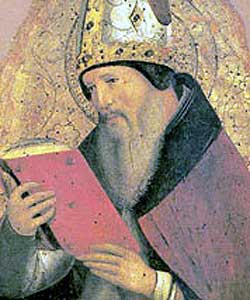
 Saint Augustine of Hippo (354-430)
"Next, those matters that are plainly laid down in them, whether rules of life or rules of faith, are to be searched into more carefully and more diligently; and the more of these a man discovers, the more capacious does his understanding become. For among the things that are plainly laid down in Scripture are to be found all matters that concern faith and the manner of life—to wit, hope and love, of which I have spoken in the previous book." (St. Augustine of Hippo, On Christian Doctrines, Book II Ch. 9)
"What more shall I teach you than what we read in the apostles? For Holy Scripture fixes the rule for our doctrine, lest we dare be wiser than we ought. Therefore I should not teach you anything else except to expound to you the words of the Teacher." (St. Augustin of Hippo, De Bono Viduitatis.)
"If anyone preaches either concerning Christ or concerning His church or concerning any other matter which pertains to our faith and life, to say nothing of ourselves, who are by no means to be compared with him who said, "Though we," at any rate, as he went on to say, 'if an angel from heaven should preach to you anything besides what you have received in the Scriptures of the Law and of the Gospels, let him be anathema.'" (Augustine, Contra litteras Petiliani, Bk 3, ch. 6.)
"It is evidently a falling away from the faith, and a proof of great presumption, to neglect any part of what is written, or to introduce anything that is not written [in the Holy Writ]." (St. Basil c. 329-379, bishop of Caesarea, de Vera Fide)
"But we are not content simply because this is the tradition of the Fathers. What is important is that the Fathers followed the meaning of the Scripture." (St. Basil the Great, On the Holy Spirit, Ch. 7)
"What is the mark of a faithful soul? To be in these dispositions of full acceptance on the authority of the words of Scripture, not venturing to reject anything nor making additions. For, if ‘all that is not of faith is sin’ as the Apostle says, and ‘faith cometh by hearing and hearing by the Word of God,’ everything outside Holy Scripture, not being of faith, is sin." (St. Basil the Geat, The Morals, p. 204, vol 9 TFOTC)
'The hearers taught in the Scriptures ought to test what is said by teachers and accept that which agrees with the Scriptures but reject what is foreign' (St. Basil the Great, Moralia 72:1)
"They are charging me with innovation, and base their charge on my confession of three hypostases, and blame me for asserting one Goodness, one Power, one Godhead. In this they are not wide of the truth, for I do so assert. Their complaint is that their custom does not accept this, and that Scripture does not agree. What is my reply? I do not consider it fair that the custom which obtains among them should be regarded as a law and rule of orthodoxy. If custom is to be taken in proof of what is right, then it is certainly competent for me to put forward on my side the custom which obtains here. If they reject this, we are clearly not bound to follow them. Therefore let God-inspired Scripture decide between us; and on whichever side be found doctrines in harmony with the word of God, in favour of that side will be cast the vote of truth." (St. Basil the Great, Letters 189.3)
"Vainly then do they run about with the pretext that they have demanded Councils for the faith's sake; for divine Scripture is sufficient above all things;" (St. Athanasius, De Synodis, I.6)
"The holy and inspired Scriptures are fully sufficient for the proclamation of the truth." (St. Athanasius, Against the Heathen, I:3)
'Everything in the divine Scriptures is clear and straightforward; they inform us about all that is necessary' (St. John Chrysostom, Homilies on 2nd Thess 3,4)
"When we receive money, we do not trust to those who give it to us; we wish to count it ourselves: and when there is a question of Divine things, would it not be a folly rashly and blindly to receive the opinions of others, when we have a rule by which we can examine everything? I mean the Divine law. It is for this reason that I conjure you all, without resting in the slightest degree on the judgment of others, to consult the Scriptures." (St. John Chrysostom c. 347-407, Homil. xiii. in 2 Cor.)
"`Tis from ignorance of Scripture that all our evils arise; hence the plague of so many heresies, hence our careless lives, our fruitless labors. They err who look not to the bright rays of the divine Scriptures, because they walk in darkness." (St. John Chrysostom, Homilies on the Romans)
"But as we do not deny what is written, so we do reject what is not written." (St. Jerome, Helvidium juxta finem, 21)
"But perhaps being refuted as touching the term Unoriginate also, they will say according to their evil nature, 'It behoved, as regards our Lord and Saviour Jesus Christ also, to state from the Scriptures what is there written of Him, and not to introduce non-scriptural expressions.' Yes, it behoved, say I too; for the tokens of truth are more exact as drawn from Scripture, than from other sources." (St. Athanasius, De Decretis, 32)
____________

fore as by the offense of one upon all men to condemnation, even so by the justification of One upon all men unto justification of life." This "offense of one," if we are bent on "imitation," can only be the devil’s offense. Since, however, it is manifestly spoken in reference to Adam and not the devil, it follows that we have no other alternative than to understand the principle of natural propagation, and not that of imitation, to be here implied. [XIV.] Now when he says in reference to Christ, "By the justification of one," he has more expressly stated our doctrine than if he were to say, "By the righteousness of one;" inasmuch as he mentions that justification whereby Christ justifies the ungodly, and which he did not propose as an object of imitation, for He alone is capable of effecting this. Now it was quite competent for the apostle to say, and to say rightly: "Be ye imitators of me, as I also am of Christ;" but he could never say: Be ye justified by me, as I also am by Christ; — since there may be, and indeed actually are and have been, many who were righteous and worthy of imitation; but no one is righteous and a justifier but Christ alone. Whence it is said: "To the man that believeth on him that justifieth the ungodly, his faith is counted for righteousness." Now if any man had it in his power confidently to declare," I justify you," it would necessarily follow that he could also say, "Believe in me." But it has never been in the power of any of the saints of God to say this except the Saint of saints, who said: "Ye believe in God, believe also in me;" so that, inasmuch as it is He that justifies the ungodly, to the man who believes in him that justifieth the ungodly his faith is imputed for righteousness. [Saint Augustine's Anti-Pelagian Works, A Treatise on the Merits and Forgiveness of Sins and on the Bap, Book 1, Chapter 18 - Only Christ Justifies]